
What to do after a car crash: a step-by-step guide from the scene to your claim
Stopping, exchanging details and, if needed, reporting to the police within 24 hours are legal duties. The right evidence and the right order of steps shape how your claim turns out.

The legal duty: stop
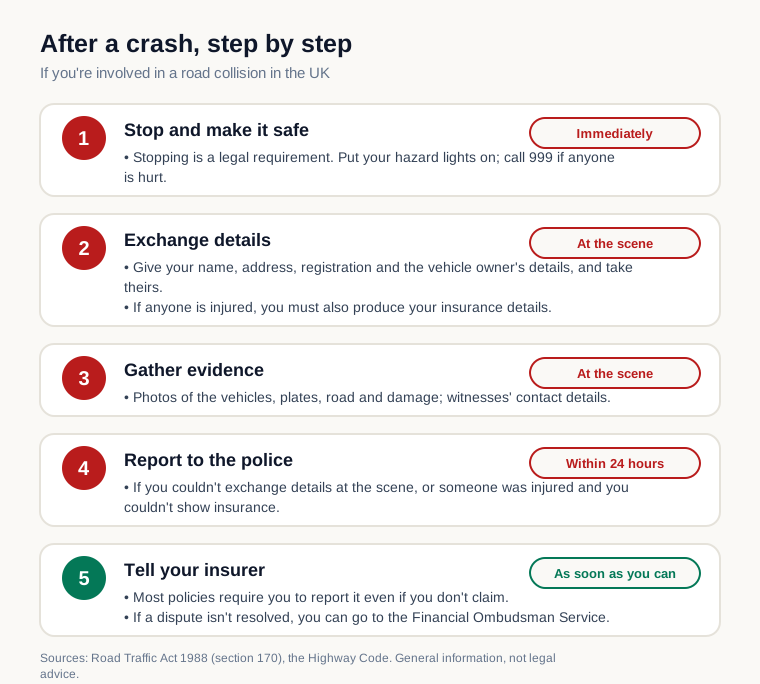
Under section 170 of the Road Traffic Act 1988, you must stop if your vehicle is involved in a collision in which someone is injured or a vehicle or property is damaged. Pull over somewhere safe, turn on your hazard lights and switch off the engine. Call 999 if anyone is hurt or the road is dangerously blocked. If nobody is hurt and there's no danger, you can call 101 for non-emergency reports.
Exchange details
You must give your name and address, the vehicle owner's name and address and the registration number to anyone with reasonable grounds to ask, and take the same details from the other driver. If anyone is injured you must also produce your insurance details. Avoid admitting fault or apologising at the scene; fault is decided by insurers and, if necessary, the courts.
Gather evidence
Use your phone to photograph the position of the vehicles, the damage, number plates, road markings, and weather and light conditions. Take witnesses' names and phone numbers. If you have a dash cam, keep the footage. If you suspect the other driver is uninsured, you can check whether a vehicle is insured through askMID.
When to report to the police
If you couldn't exchange details at the scene (for example, you hit a parked car with no owner present), or someone was injured and you couldn't show your insurance, you must report the collision to the police as soon as possible and in any case within 24 hours. Also report it if the other driver failed to stop; the Motor Insurers' Bureau (MIB) can compensate for damage caused by uninsured or hit-and-run drivers.
Telling your insurer and claiming
Most policies require you to tell your insurer within a reasonable time even if you don't intend to claim; failing to do so can put your cover at risk. If you weren't at fault, always ask about the cost, and who pays, for any 'accident management' or replacement car services that call you. If you have a dispute with your insurer, complain formally first; if it isn't resolved within 8 weeks you can go to the Financial Ombudsman Service for free. This article is general information, not financial or legal advice.
This article is general information, not legal or financial advice. Always check the latest rules on GOV.UK or with a regulated professional.
Sources
- legislation.gov.uk — Road Traffic Act 1988, section 170
- The Highway Code — Incidents, accidents and emergencies
- Motor Insurers' Bureau
- Financial Ombudsman Service
Contains public sector information licensed under the Open Government Licence v3.0.


