Beyond the label: building sustainability through pattern, stitch and durability
If a garment loses its shape after three washes, it isn't sustainable, however ecological the cotton. Senior Garment Technologist Burçin Fulkar explains how sustainability is really built on the production line, from recycled fibres to returns.


In London fashion, the words we hear most these days are "organic", "recycled" and "circular". But after 15 years inside the production teams of major global brands as a garment technologist, the clearest lesson I've learnt is this: sustainability is not just a certificate printed on a fabric label.
If a garment loses its shape after three washes, splits at the seams or ends up at the back of the wardrobe because it doesn't fit, it isn't sustainable, even if it's made from the most ecological cotton in the world. Real sustainability starts on that fine technical line between the design table and the production line.
Putting "recycled" fibres to the test
In meetings with design teams, nothing generates more excitement than next-generation sustainable fabrics. But once we sit down at the technical table, we come up against the physical limits of these fibres.
In mechanically recycled cotton or polyester blends, for example, the fibres are shorter. That lowers the fabric's resistance to pilling and weakens its tear strength. Our job as technologists isn't to reject these fabrics but to support them with the right engineering.
Stitch density and needle choice (SPI): On a fabric with weakened fibres, a standard stitch density (stitches per inch) can cut through the cloth. Recalibrating needle size (choosing a ball-point needle, for instance) and thread tension around the fabric's weak points can extend a garment's life from months to years.
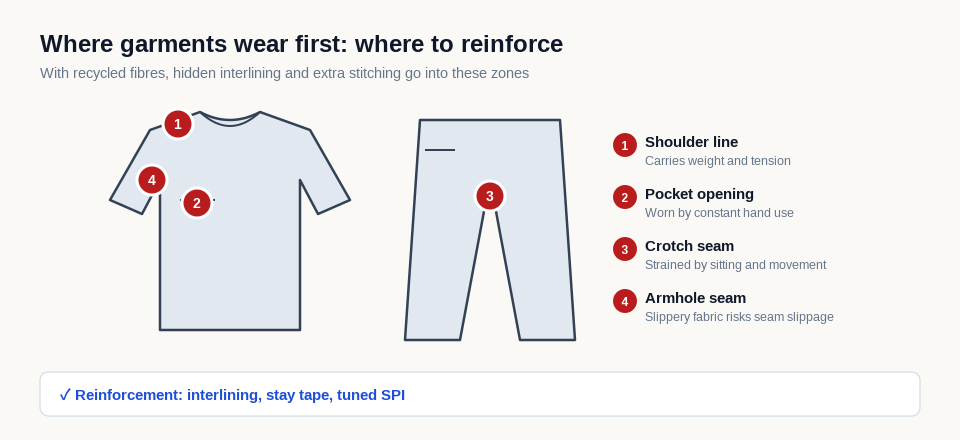
Strategic reinforcement: In the areas most exposed to wear (pocket openings, crotch seams and shoulder lines), hidden interlining or extra stitching can lengthen the fabric's structural life.
The hidden waste: poor fit and returns
In the UK and European e-commerce market, return rates are the industry's biggest open wound. When a customer sends back an item because the size is wrong, the resulting carbon footprint and logistics waste can often be as damaging as the water used to make it.
Well-designed fit engineering is one of the most powerful environmental strategies there is.
Consistent sizing: Using a base pattern (block) suited to the brand's customers and refined with data over the years stops shoppers ordering two sizes "just in case" and returning one.
Anticipating fabric behaviour: A pattern is more than a two-dimensional drawing. If a fabric's stretch and recovery and its shrinkage after washing aren't built into the pattern correctly, the garment becomes unwearable after the first wash. Every garment that ends up in the bin is the result of a technical process that failed.
A case from the factory floor: shrinkage and seam slippage in sustainable viscose
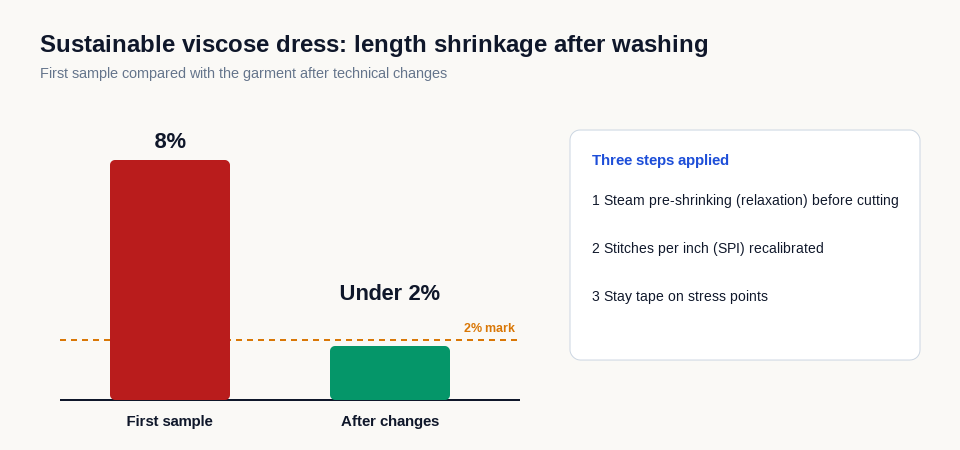
For a recent collection I worked on, the design team created a midi dress in 100% certified sustainable (FSC-approved) viscose, chosen for its fluid drape. When the first sample went through wash testing, we hit two critical problems: aggressive length shrinkage of up to 8% and seam slippage at the armholes. Had it gone into production as it was, the dress would have shrunk a size and come apart at the seams on its first wash, turning thousands of garments straight into waste.
The technical fix: Rather than abandon the fabric, we intervened in production in three stages. First, the fabric was steam pre-shrunk (relaxed) on the roll at the mill before cutting, holding shrinkage below 2%. Next, the stitch density (SPI) was recalibrated to grip viscose's slippery fibres. Finally, a fine woven fusible stay tape was applied at the stress points. The result: we rescued what became one of the collection's best-selling styles, with one of its lowest return rates.
Designing for circularity
With the European Union's Digital Product Passport (DPP) and extended producer responsibility rules, we now have to plan not only how a garment is made but how it will be recycled at the end of its life: designing for longevity and disassembly. Technically, that means:
A mono-material approach: Using polyester sewing thread or non-removable metal or plastic trims on a 100% cotton shirt makes it harder to recycle chemically or mechanically later on. Choosing thread and trims from the same fibre family wherever possible keeps future recycling costs to a minimum.
Repairability: Leaving slightly wider seam allowances, or attaching parts that are likely to fail, such as zips, with techniques that make them easy to remove and replace, gives customers the option to repair a garment rather than throw it away.
Tomorrow's technologist is a "lifespan specialist"
The fashion industry is changing fast. A garment technologist's core job used to be getting samples into production flawlessly at the lowest cost; today our role has become far more strategic.
My experience in London has shown me this: the most successful brands of the future won't be the ones running the most sustainability campaigns, but the ones making clothes that stay in their customers' wardrobes for five years, keeping the shape they had on day one. Real sustainability is hidden in the sewing machine needle and in the millimetres of the pattern table.
This article is general information, not legal or financial advice. Always check the latest rules on GOV.UK or with a regulated professional.