
Buying insurance? 10 mistakes that can void your policy
A wrong answer, 'fronting' or undeclared business use can mean a claim is refused when you need it. What to watch for when hunting for a cheaper policy.

1. Answer questions accurately
The Consumer Insurance (Disclosure and Representations) Act 2012 requires you to take reasonable care to answer an insurer's questions accurately. If you give wrong or incomplete information about your address, job, licence history, past claims or convictions, the insurer can refuse or reduce a claim or cancel the policy. Deliberate misrepresentation is fraud.
2. Don't 'front'
'Fronting' is when a parent is listed as the main driver to cut the premium while a young or new driver, put on as a named driver, actually uses the car most. It is insurance fraud: claims can be refused, the policy cancelled, and the record can make insurance harder to get later.
3. Choose the right class of use
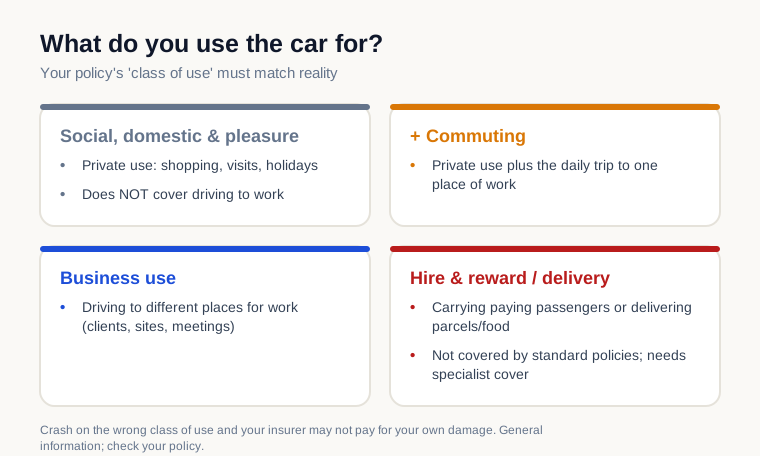
'Social, domestic and pleasure' cover doesn't include driving to work; you need 'commuting' for that. Driving to different places for work needs 'business use'. Food and parcel delivery (such as Deliveroo, Uber Eats or Amazon Flex) is not covered by standard policies; you need 'hire and reward' or delivery insurance. Crash while delivering on a private-use policy and your insurer may not pay for damage to your own car.
4. Mileage, parking and modifications
Give a realistic annual mileage. State correctly where the car is kept overnight (garage, driveway or street). Always declare modifications such as non-standard wheels, exhausts, paint or performance changes; undeclared changes cause problems at claim time.
5. Read the IPID and the excess
Every policy should come with a short Insurance Product Information Document (IPID). Use it to check the total excess (compulsory plus voluntary), extra excesses for young or new drivers, and windscreen and courtesy car terms. A high excess is often what makes a cheap policy cheap.
6. Work out the cost of paying monthly
Paying monthly is usually more expensive than paying upfront, because monthly instalments are often an interest-bearing credit agreement. Check the total amount repayable and the APR, and pay annually if you can.
7. Compare at renewal
Under FCA rules in force since 2022, a renewal price cannot be higher than the price for an equivalent new customer through the same channel. That doesn't mean other insurers won't be cheaper. Check your auto-renewal and get quotes before the date.
8. Know your cooling-off right
Most insurance policies come with a 14-day cooling-off period from the start date or when you receive the documents. If you cancel within it, you get the premium back minus the days used and any admin fee.
9. Keep proof of your no claims history
Some insurers accept no claims history from other countries for drivers moving to the UK; be ready to provide a dated letter in English on the previous insurer's letterhead. Whether it's accepted varies by insurer.
10. Know how to complain
If you have a dispute with your insurer, first make a formal complaint to the company. If it isn't resolved within 8 weeks, or you're unhappy with the final response, you can go to the Financial Ombudsman Service for free. This article is general information, not financial or legal advice.
This article is general information, not legal or financial advice. Always check the latest rules on GOV.UK or with a regulated professional.
Sources
- legislation.gov.uk — Consumer Insurance (Disclosure and Representations) Act 2012
- FCA — General insurance pricing practices
- Financial Ombudsman Service
- ABI — Association of British Insurers
Contains public sector information licensed under the Open Government Licence v3.0.


