
Employing staff and running payroll (PAYE) in the UK: 2026 minimum wage, employer NI and sponsorship costs
The National Living Wage rose to £12.71 an hour in April 2026. The real cost of an employee, including employer NI, auto-enrolment pensions and sponsorship fees for businesses hiring from abroad.

Minimum wage (April 2026)
The National Living Wage for workers aged 21 and over is £12.71 an hour. The rate is £10.85 for 18–20-year-olds and £8.00 for under-18s and apprentices; the apprentice rate applies to under-19s and to older apprentices in their first year. Employers who underpay face arrears, penalties and public naming.
PAYE and employer NI
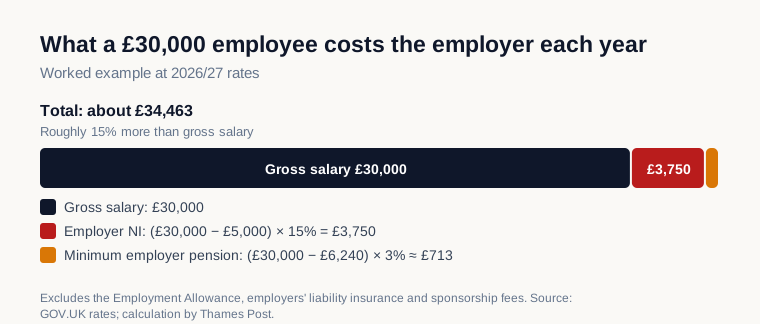
Employers must register with HMRC and run payroll through PAYE, reporting each payday in real time (RTI). Employer National Insurance is 15% on pay above £5,000 a year. Eligible businesses can claim up to £10,500 a year through the Employment Allowance.
Workplace pensions
Under auto-enrolment you must put eligible staff into a workplace pension. The minimum total contribution is 8% of qualifying earnings (between £6,240 and £50,270 a year), with at least 3% from the employer. The Pensions Regulator can fine employers who don't comply.
Hiring from abroad: sponsorship costs
Hiring on a Skilled Worker visa needs a sponsor licence. According to published figures, the licence costs £611 for small businesses and £1,682 for medium and large ones, and each Certificate of Sponsorship costs £525. Since December 2025 the Immigration Skills Charge is £480 for the first 12 months for small sponsors and £1,320 for medium and large ones, and can't be passed to the worker. Minimum salary thresholds have also risen.
The real cost of an employee
An employee costs more than their gross pay: budget for employer NI, pension contributions, employers' liability insurance (a legal requirement) and any sponsorship fees. Checking a worker's right to work in the UK before hiring is also a legal duty, with heavy penalties for employers who don't. This article is general information, not tax, financial or legal advice. Speak to a qualified accountant about your own situation.
This article is general information, not legal or financial advice. Always check the latest rules on GOV.UK or with a regulated professional.
Sources
- GOV.UK — National Minimum Wage and National Living Wage rates
- GOV.UK — Workplace pensions
- Sterling and Wells — Immigration Skills Charge 2026
- Tarve — UK visa sponsorship costs 2026
Contains public sector information licensed under the Open Government Licence v3.0.


