
How to get a driving licence in the UK: a step-by-step guide from provisional licence to practical test
From L plates and the theory test to booking your test and what happens on the day: every step of getting a car licence in Great Britain, with current fees and official links — plus a section for people arriving with a Turkish licence.

Who this guide is for
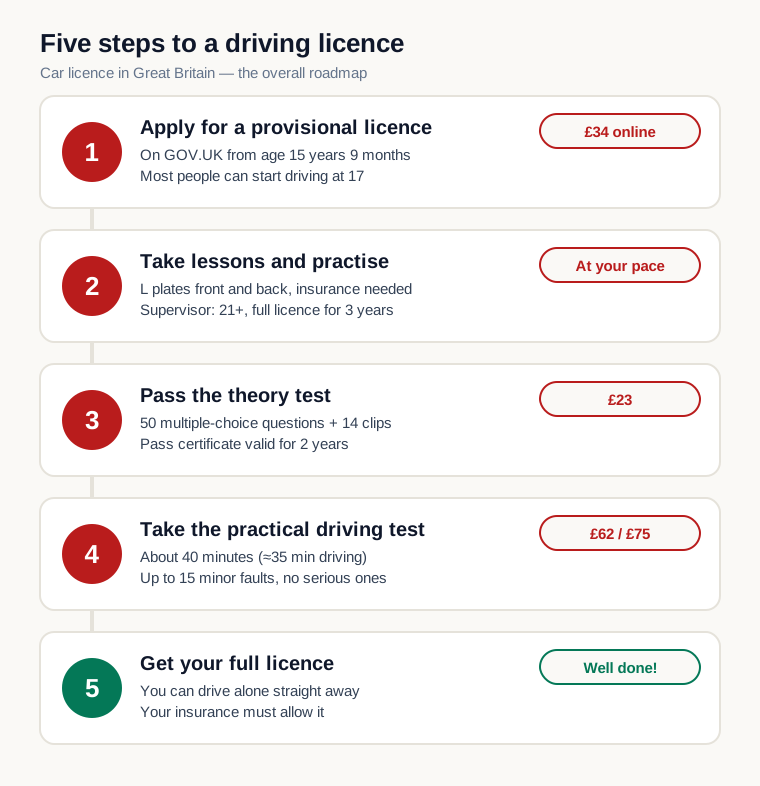
It's for young people getting their first licence in the UK, people from Türkiye who want to drive here, and parents following their child's journey. There are five main steps: provisional licence, lessons and practice, theory test, practical test and full licence. Below we go through each step in order, based on the official rules and fees. Rules and fees change from time to time, so always check GOV.UK before you apply.
Step 1: Apply for a provisional licence
Everything starts with a provisional licence. You can apply on GOV.UK from age 15 years and 9 months, and most people can start driving at 17. It costs £34 online or £43 by post (form D1). You must have permission to live in Great Britain for at least 185 days and be able to read a number plate from 20 metres. You may be asked to prove your identity; online applicants usually get their licence within a week.
Step 2: L plates, supervisors and insurance
You can't drive alone on a provisional licence. You must display L plates on the front and back (D plates can also be used in Wales). If you practise with family or friends, your supervisor must be over 21 and have held a full licence for at least 3 years, and must not use a phone while supervising. You also need insurance that covers you as a learner. Driving without proper supervision can mean a fine of up to £1,000 and 6 penalty points; driving uninsured can mean an unlimited fine, up to 8 points and a ban. Practising on motorways with family or friends is illegal.
Step 3: Learn with a qualified instructor
Paid lessons can only be given by DVSA-approved driving instructors (ADIs), who display an official badge on the windscreen. You can find local schools with the GOV.UK search tool. One important choice: pass your test in an automatic and your licence only covers automatics; pass in a manual and you can drive both. How many lessons you need varies hugely — wait until your instructor says you're ready rather than rushing.
Step 4: How to study for the theory test
The theory test is based on the Highway Code. Official resources include the free practice theory test on GOV.UK, DVSA's official theory and hazard perception app, and the list of 'show me, tell me' vehicle safety questions. The test is in English or Welsh and interpreters aren't allowed, so learning the terms early pays off if your English is weaker. Short daily practice and rehearsing your click timing on hazard perception clips work best.
Theory test day
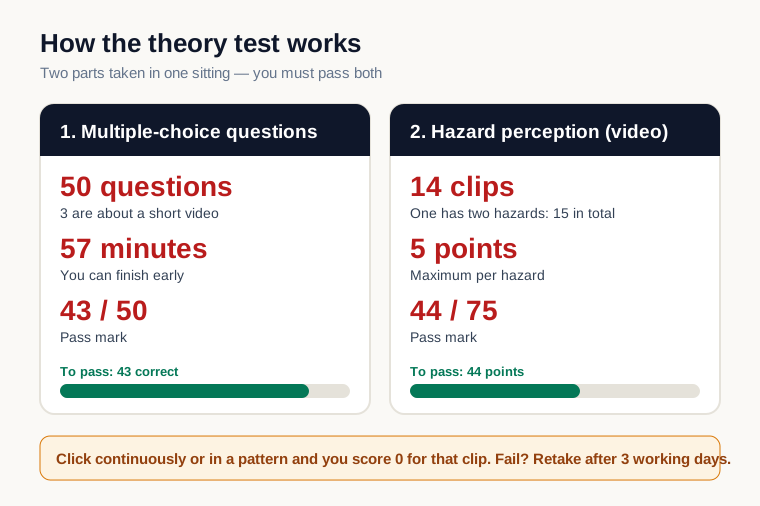
Book the theory test for £23 on the official GOV.UK booking page; you need a provisional licence to book. It has two parts you must pass in one sitting: 50 multiple-choice questions in 57 minutes (pass mark 43) and hazard perception with 14 clips (pass mark 44 out of 75). You get your result on the day. Your pass certificate lasts 2 years — pass your practical test in that time or you'll need to retake the theory. If you fail, you can rebook for at least 3 working days later.
Step 5: How to book your practical test
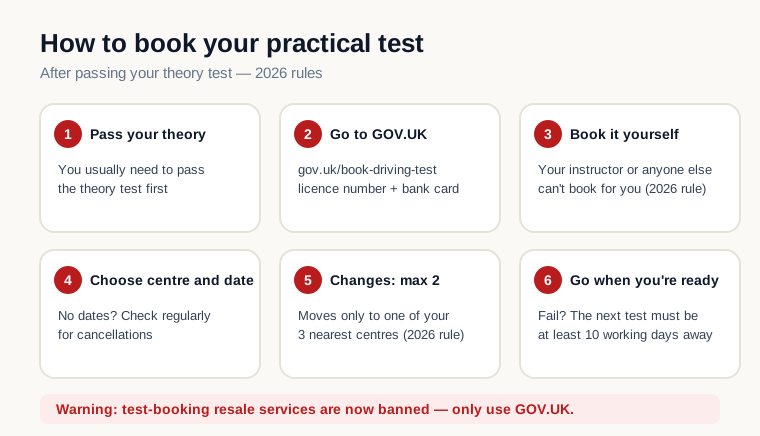
Book your practical test on GOV.UK once you've passed your theory. It costs £62 on weekdays and £75 on evenings, weekends and bank holidays. You need your licence number and a bank card, and can add your instructor's reference number to see their availability. Rules tightened in 2026: only learners can now book and change their own tests — instructors and booking services can't do it for you. You can change a test no more than twice, and can only move it to one of your three nearest centres. You must also have lived in Great Britain for at least 185 days in the previous 12 months. Waits can be long at some centres, so checking regularly for cancellations helps.
How to prepare for the practical test
Do at least one mock test with your instructor — seeing how the test is marked takes away a lot of stress. Learn all the official 'show me, tell me' questions; two come up in the test. Practise every reversing manoeuvre — parallel parking, parking bays and pulling up on the right — since you won't know which you'll get. DVSA doesn't publish test routes, so practising around the test centre's junctions, narrow streets and changing speed limits is good preparation. If you'll use your own car, check it meets DVSA's vehicle rules in advance.
What happens on test day
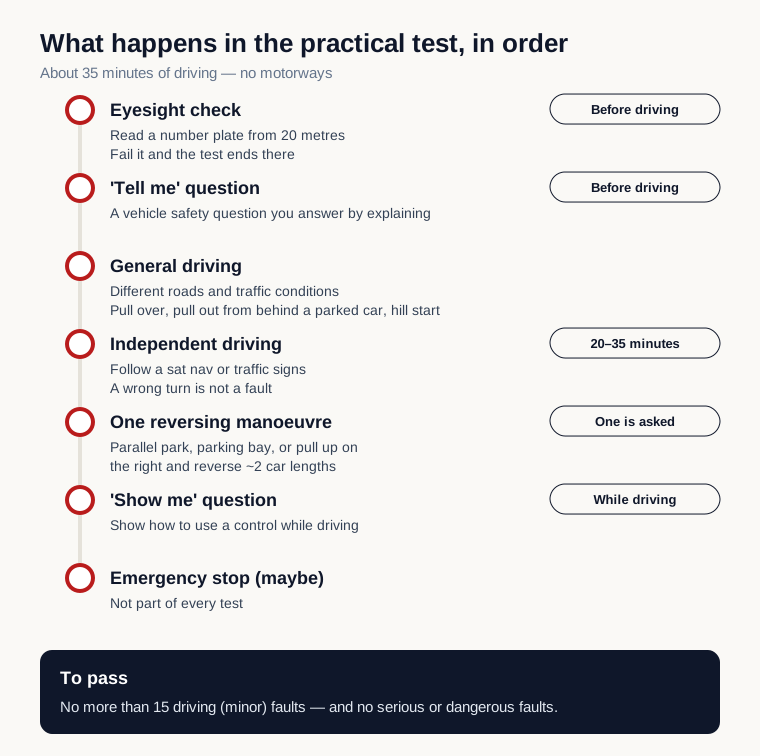
The test takes about 40 minutes, around 35 of them driving. First you read a number plate from 20 metres — fail that and the test ends. Then comes a 'tell me' question. You drive in general traffic, pull over, pull out from behind a parked car and do a hill start. For 20 to 35 minutes you drive independently following a sat nav or signs; taking a wrong turn isn't a fault. There's one reversing manoeuvre and a 'show me' question while driving, and some tests include an emergency stop. Motorways aren't included.
The result: what it takes to pass
Faults come in three kinds: driving (minor), serious and dangerous. To pass you can make up to 15 driving faults and no serious or dangerous ones. If you pass, you can hand your provisional licence to the examiner to have your full licence sent automatically, and you can start driving alone straight away as long as your insurance allows it. If you fail, you pay again and book a date at least 10 working days away. Remember: new drivers who reach 6 penalty points within 2 years of passing lose their licence.
If you hold a Turkish licence
Türkiye is not one of the 'designated countries' whose licences can be exchanged directly for a British one. Under the general rule, people from these countries can drive small vehicles on their own licence for up to 12 months after becoming resident. To keep driving after that, you need a provisional licence and must pass the theory and practical tests. Given test waiting times, starting well before your 12 months are up is wise. Check your own situation with GOV.UK's non-GB driving licence tool.
Things to watch out for
Only book tests on GOV.UK — booking resale services are now banned and you could lose your money. Never drive uninsured or unsupervised. Take your provisional licence on test day; without it you won't be allowed to sit the test. And failing the first time is very common — treat it as experience and work through the examiner's feedback with your instructor.
This article is general information, not legal or financial advice. Always check the latest rules on GOV.UK or with a regulated professional.
Sources
- GOV.UK — Apply for your first provisional driving licence
- GOV.UK — Theory test: pass mark and result
- GOV.UK — What happens during the driving test
- GOV.UK — Driving test faults and your result
- GOV.UK — Driving test cost
- GOV.UK — Learning to drive with family or friends
- DVSA — Changes to driving test booking from 31 March 2026
- GOV.UK — End of the road for unofficial driving test booking services
Contains public sector information licensed under the Open Government Licence v3.0.


