
The 'black sky' warning: is a nationwide blackout coming? The facts and a 3-day preparation list
A social media claim of a nationwide blackout on 19 November spread widely; National Grid says it is false. Separately, the government advises households to keep three days of supplies. Preparation, not panic.

What happened
The phrase 'black sky' has been everywhere on UK social media and in the news. A post made to look as if it came from National Grid claimed there would be a nationwide blackout from 4pm on Thursday 19 November because of a 'critical fault'. At the same time, a government campaign urging households to prepare for emergencies has been in the headlines. The two got mixed up and worried many people.
The 19 November claim is false
National Grid said it was aware of the fake post and that no outage is expected, asking people to ignore it, report it as misinformation and follow its official channels. In short: there is no planned or forecast national power cut on 19 November.
What 'black sky' means
'Black sky' is an informal industry and media term for the worst case — a long power cut across the whole country or most of it. In official documents the equivalent is the 'national power outage' risk in the National Risk Register published in July 2026. The register describes it as low likelihood but with severe consequences that could knock on to water, communications and transport. It notes that most power cuts are short and local.
What the government advises
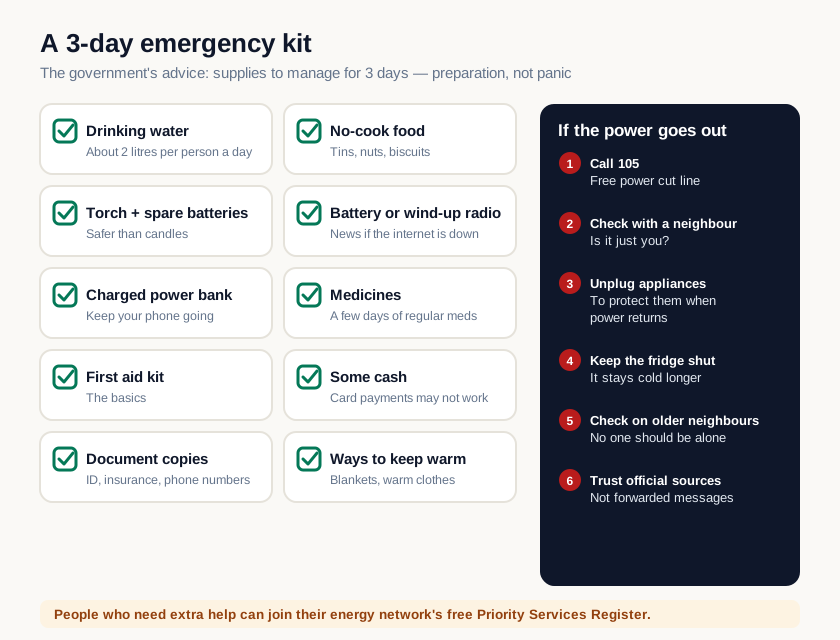
The government's 'Be Ready' campaign recommends that households keep enough supplies to manage for three days during temporary interruptions to electricity, water or phone networks. It is a long-term preparedness campaign, not a warning about a specific threat. A Cabinet Office survey found only 13% of households said they were largely or fully prepared.
What to keep at home
A basic kit includes drinking water, food that needs no cooking, a torch with spare batteries, a battery or wind-up radio, a charged power bank, a few days of regular medicines, first aid supplies, some cash and copies of important documents. In winter, add blankets and warm clothing. If your power goes off, call the free 105 line to report it and find out when it will be back.
Against misinformation
Claims like this spread quickly, especially in WhatsApp groups. Before forwarding a warning, check where it came from: if it isn't on the website or verified accounts of official bodies such as National Grid, the Met Office or GOV.UK, don't pass it on. In a real emergency, official warnings are also sent to phones through the Emergency Alerts system.
This article is general information, not legal or financial advice. Always check the latest rules on GOV.UK or with a regulated professional.
Sources
- GOV.UK — Be Ready campaign
- GOV.UK — A Guide to the 2026 National Risk Register
- Tyla — National Grid statement on false blackout claims
- ITV News — Why Britons are being told to prepare
Contains public sector information licensed under the Open Government Licence v3.0.


